
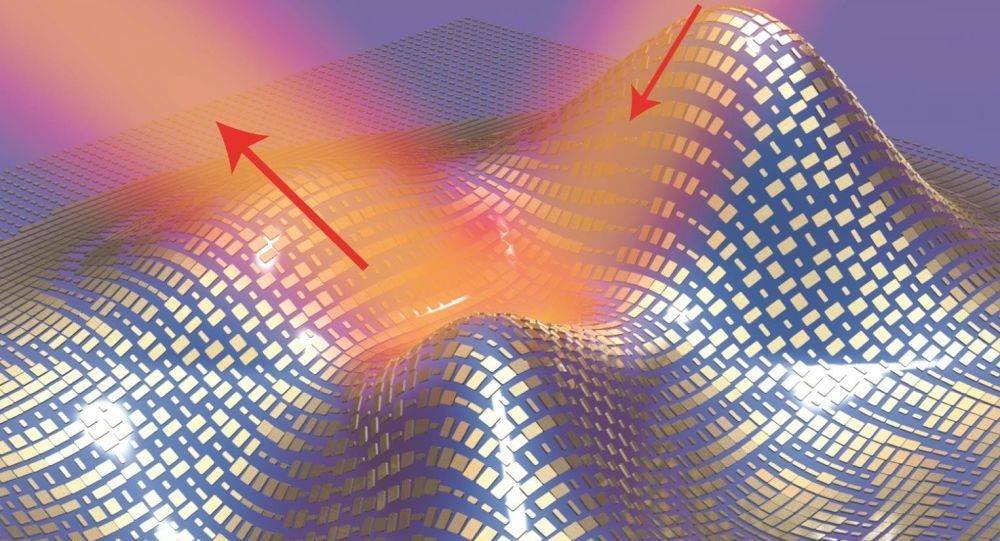
Russian scientists with or below the development of " concealment packaging "
Physicians from the National University of St. Petersburg to search for information, mechanics, optics and a number of foreign scientific centres have arrived at how to make nano-biotic particles perform and disperse light by side (not forward or backward).
According to the " Physical Review Letters " magazine, this characteristic helps to create invisible materials, as well as new types of sensors and images.
According to Spotnik ' s Arab site, Aleksandre Shalin, of the National University of St. Petersburg, we combined the impact of the Crecker world and reversed its impact for the first time. We have reached a new level of lighting control. Moreover, the problem was the lack of physical understanding of the process and information about teachers that gave organisms such a unique visual response. We and our foreign colleagues have been able to describe it.
Light dissemination mechanism
The light is spread in completely different ways and interacts with large bodies of the physical world, such as lenses, mirrors or human body, and small organisms, including nanosal atoms and particles, whose dimensions are significantly smaller than their wavelength.
In the latter case, the strength of their interactions will depend strongly on the characteristics of the Fotone itself, which lead to many strange influences, in particular, why the sky is blue and why it turns red during sunset and sunrise.
This feature of light is being actively used today in the development of many optical materials and a number of other scientific tools.
According to Shalin and his colleagues, the famous American physicist, Milton Crecker, discovered one of the most strange forms of disintegration of light. When the light interacts with the aerosols (particularities stuck in the air), sometimes it does not scatter the light randomly, but rather moves forward for its original source (which is called the Crecker influence).
Creaker's influence and light bend by side.
There is also another similar effect that causes light not to move forward, but to the back. Scientists have always tried to use each of these light features to figure out how to effectively control their movement within the light chips, to create invisible packagings and other similar structures.
Shalin said that a year ago, his colleagues from Australia invented three layers of nanomaterials that were largely shaped by the form of onions, in which both effects were observed at the same time, and as a result they began to disperse the light side, instead of front or back.
This idea attracted the attention of Russian physicists and their foreign colleagues, who wanted to obtain this effect using nano-particles with more simple connections.
Development of nanomaterials capable of concealing materials
They were able to operate nano-particles capable of interacting with microwave radiation and monitored their behaviour when exposed to such waves.
Experience has shown that these molecules have been able to disperse the light side by side without reversing it or allowing it to move forward.
Accordingly, it is very easy to operate invisible devices with the help of this type of nanosal molecules that can disperse light by side.
Shalin and his colleagues conducted the first experiments, and the results of these experiments will already be published in the world ' s leading scientific journals.
